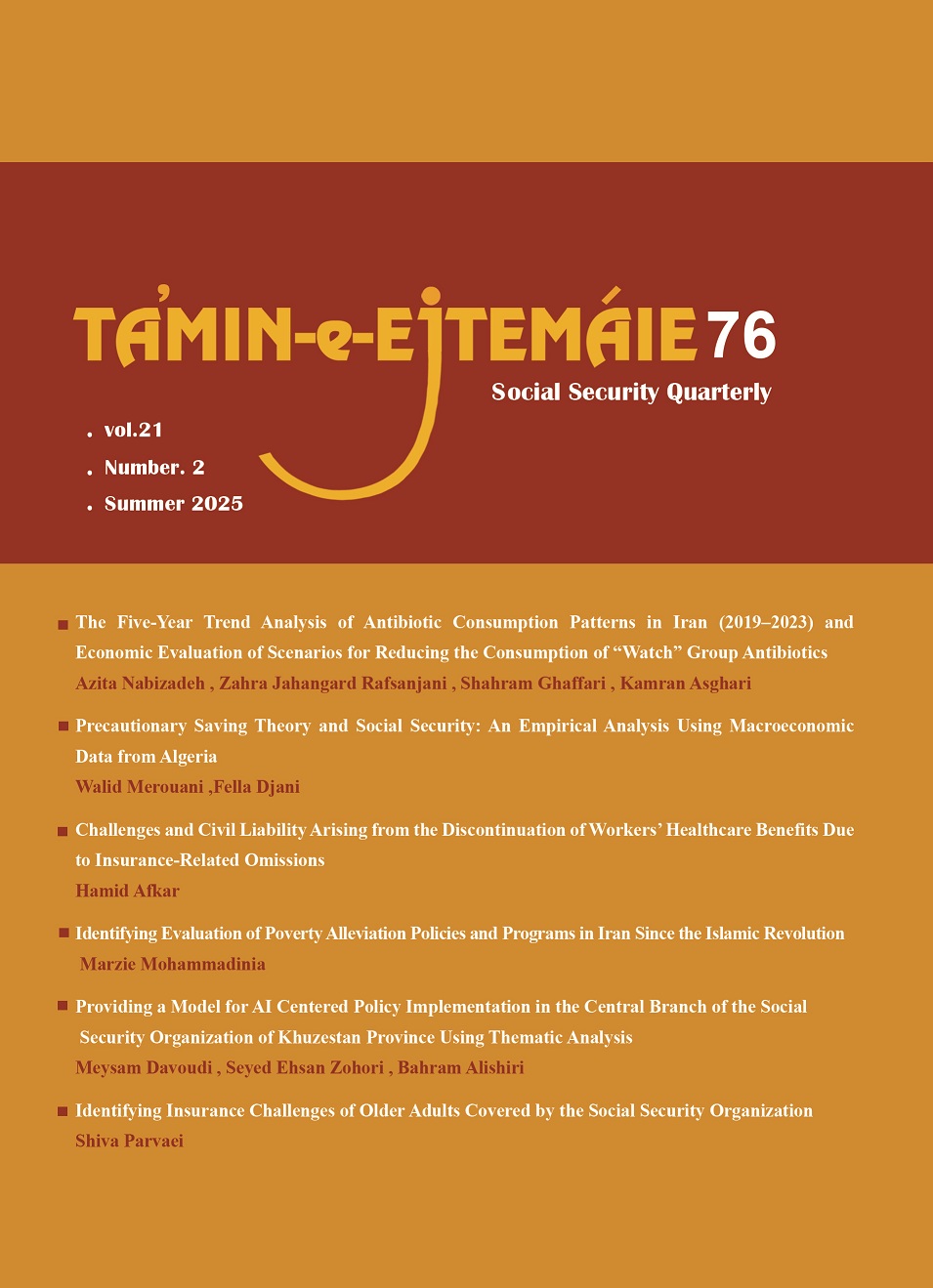
Document Type : Original Article
Author
PhD in law, Department of Law, Ma.c., Islamic Azad University, Mashhad
10.22034/qjo.2026.528859.1440
Abstract
Purpose: This study aims to elucidate the legal foundations and conditions for establishing civil liability arising from the suspension or actual discontinuation of workers’ healthcare services as a result of insurance-related omissions. The central issue is that, notwithstanding Article 36 of the Social Security Act, which expressly provides for the continuation of the Social Security Organization’s obligations even in cases where the employer fails to pay insurance contributions, a worker’s access to healthcare services may, in certain circumstances, be temporarily suspended due to administrative and operational disruptions or failure to fulfill insurance-related obligations.
Method: This study employs a descriptive–analytical approach based on library research. Relevant laws and regulations, particularly the Social Security Act, were analyzed, and selected landmark judgments of the courts and the Administrative Justice Court were examined. In addition, a comparative analysis of the approaches adopted by several legal systems regarding the continuity of healthcare coverage was conducted to strengthen the analysis.
Findings: The findings indicate that, although an employer’s failure to pay insurance contributions does not, as a matter of law, extinguish the Social Security Organization’s obligations toward the insured person, the actual suspension or discontinuation of healthcare services may nevertheless occur as a result of the employer’s omission, operational and systemic deficiencies within the Social Security Organization, or, in exceptional cases, the worker’s own conduct or negligence. The civil liability of each of these parties may arise upon establishment of the requisite elements of liability, including fault, occurrence of damage, and a causal relationship. Furthermore, the absence of an insurance grace period, the lack of an active notification system, and weaknesses in supervisory mechanisms were identified as among the most significant operational gaps contributing to the occurrence of such harm.
Conclusion:The findings demonstrate that ensuring the effective continuity of healthcare services requires reforming operational mechanisms and strengthening legal protections for insured persons. Establishing an insurance grace period, implementing a preventive notification system, enhancing the Social Security Organization’s operational infrastructure, strengthening supervision over employers’ compliance with their insurance obligations, and providing effective enforcement mechanisms are among the most important proposed measures for reducing instances of healthcare service discontinuation and ensuring effective protection of workers’ fundamental rights.
Keywords