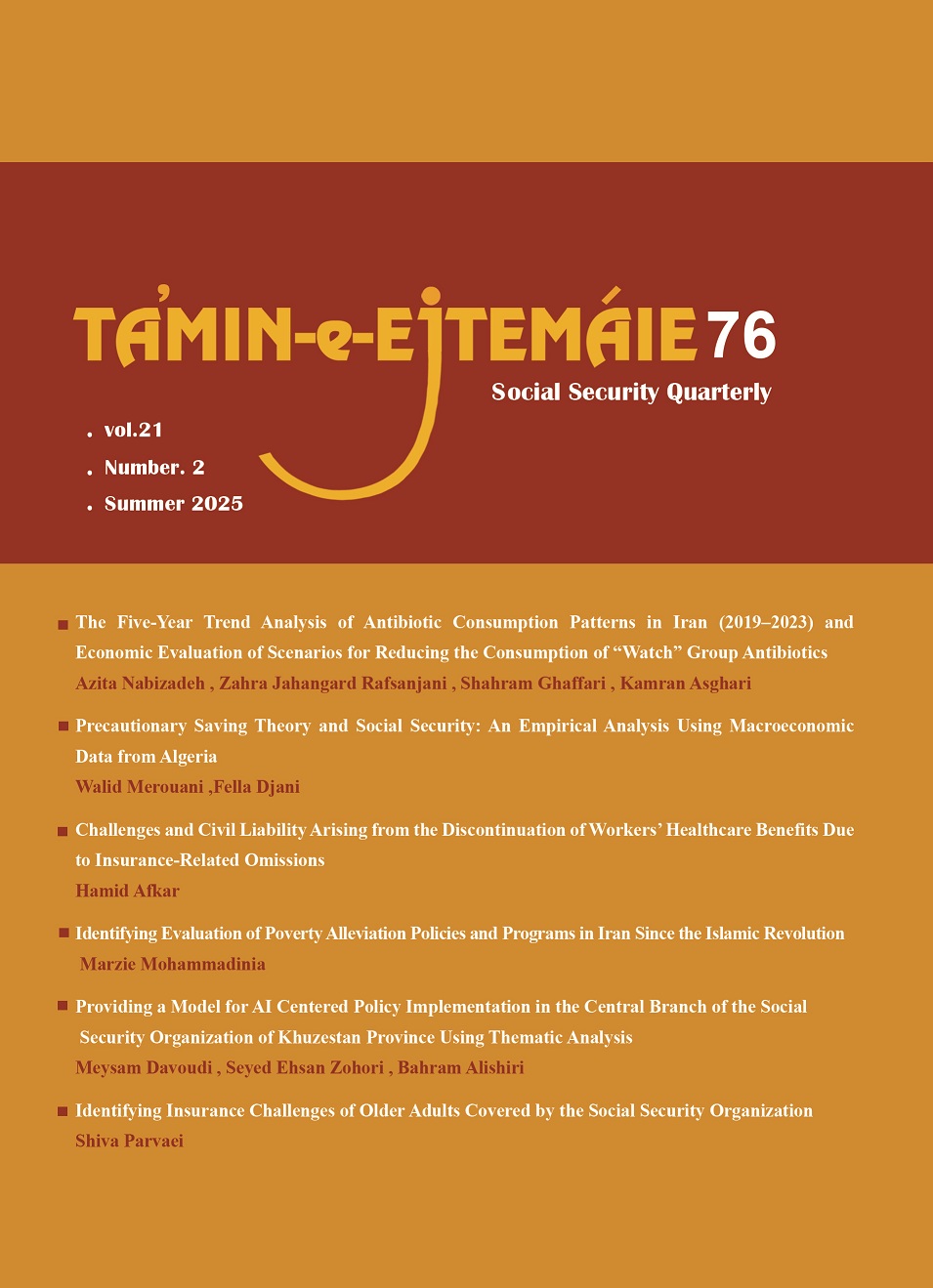
Social Security Journal

Social Security Journal

The Social Security Journal is an open-access quarterly that employs a double-blind peer-review policy for article evaluation and focuses on important and fundamental issues in the field of welfare and social security. The journal adheres to the principles and criteria of the Committee on Publication Ethics (COPE) in reviewing and publishing articles. All submitted articles are examined to ensure their originality, and then they are carefully evaluated by qualified and experienced reviewers. Research articles will be reviewed based on the journal's thematic areas.
This quarterly is made available for the academic use of professors, students, and those interested in theoretical and scientific discussions within the broad field of welfare and social security. Therefore, it publishes original research articles, as well as articles presenting new perspectives, opinions, and commentaries, along with reviews of books and articles.

Keywords Cloud

  • social security organization
  • Social security
  • social policy
  • Unemployment Insurance
  • early retirement
  • Insurance
  • employment
  • social insurance
  • Retirement
  • health system
  • Pension Funds
  • Satisfaction
  • welfare
  • Maternity Leave
  • Artificial intelligence
  • Health Insurance
  • organizational performance
  • electronic services
  • Economic shocks
  • parametric reforms
  • general social security policies
  • comparative study
  • Fraud
  • Welfare State
  • Family
  • Thematic Analysis
  • Retirement Plans
  • Internet of Things
  • Iran
  • Administrative Justice Court
  • Women
  • Service Quality
  • Healthcare services
  • Cost management
  • Asset Liability Management
  • Minimum Wage
  • inequality
  • Health Services
  • Health Expenditures
  • Professional Ethics
  • Elderly Employment
  • Working Women
  • Interpretive structural modeling
  • migrant workers
  • Investment Approaches
  • Panel Data Model
  • Risk Management
  • bayesian model
  • Informal Employment
  • Poverty
  • Efficiency
  • Neural Network
  • Human Resource Management
  • Multi-Layered Social Security System
  • Social Capital
  • Developing countries
  • Pensioners
  • Economic Growth
  • Social Welfare
  • Classification
  • Financial Resources
  • Bibliometric analysis
  • social responsibility
  • Human rights
  • financial stability
  • performance
  • Data mining
  • effectiveness
  • financial performance
  • Privatization
  • organizational commitment
  • Court of administrative justice
  • Youth Employment
  • Pension System
  • Hospital
  • social exclusion
  • retirement age
  • right to social security
  • Social protection
  • Disabled people
  • Knowledge Management
  • Innovation
  • Spatial Econometrics
  • employer-employee disputes
  • Supplementary Insurance
  • client relationship management
  • Insurance coverage behavior
  • comparative analysis
  • challenges related to the sickness benefits
  • Keywords: Social Security
  • Neorealism
  • Hazardous
  • Organization of Social Organization
  • key client
  • delicensing
  • meta-study
  • Granded Theory
  • \"learning\"
  • Medicare
  • Pension system reforms
  • perception of organizational politics
  • Three-pronged model
  • Government
  • Enterprise Size
  • Healthcare tariff
  • non-standard jobs
  • Complementary health insurance
  • Organizational Agility
  • Population policies
  • Social Security Hospitals in Qom
  • Organizational characteristics
  • Suggestion System
  • assignment
  • organizational silence
  • Social Security Fund
  • تأمین اجتماعی
  • \'\' conflict \'\'
  • Fishery Insurance
  • Bilateral Orientation
  • Sufficiency
  • oil revenues
  • Documentary Research
  • Contra Proferentem Rule
  • One-Class Support Vector Machine (One-Class SVM)
  • Index
  • Public Services
  • \"Health Reform Plan\"
  • Hybrid method
  • physical facilities
  • Freedom from Work
  • Self-Employment
  • automatic balancing mechanism
  • decision tree
  • Zoning
  • Hospital management
  • Non-Work Related Disability Insurance
  • Involuntary Unemployment
  • International Collaboration
  • \"cultural responsibility\"
  • stakeholder, engagement
  • Internal and External Control
  • Durkheim
  • Note to Article 77
  • Patronage
  • work-family conflict
  • actuarial balance
  • Optimization Technique
  • Trust
  • moral economics
  • Organizational Culture
  • A U.S. Case Study
  • yellow vests
  • Corona Pandemic
  • discourse creation
  • \"sustainability
  • Commitments- Expansion of liquidity claims
  • service Training
  • Voluntary disclosure of information
  • Seventh Development Plan
  • Corona Crisis
  • Baby boomer- Yellow vests movement- France- Vincent Tiberj
  • Cost
  • Organizational Justice
  • optimal scenario
  • حوادث حین کار
  • Third cinema
  • historical simulation
  • Meta-Synthesis
  • cost of living
  • structural conflict of interest
  • \"agility\"
  • old age
  • Financial Sustainability
  • optimization
  • Protestant ethics
  • non-scheduled distribution
  • health care tariffs
  • Process Risk
  • Generalized method of moments
  • Job Creation Policies
  • human resource
  • \"Retirement\"
  • Zachman and IoT
  • Social Inequality
  • Labor Market
  • concentration
  • the flow of resources and costs
  • Altruism
  • welfare and social security
  • Clientelism
  • insurance fraud
  • drug consumption pattern
  • Digital literacy
  • \"Disability\"
  • celibacy
  • comprehensive system
  • Social Responsibility Disclosure
  • Natural Language Processing (NLP)
  • Performance Management
  • staff performance